The short answer: printed window film puts a custom design, pattern or logo on glass, and it works best as a finishing layer on an architectural film project rather than a project on its own. For offices, a custom print on clear film can add privacy and brand identity in one step. For storefronts, short-term promotional graphics are a different product with a much shorter life. Decide what the glass needs to do first, then decide whether a print adds enough to be worth the design time.
Comfort Pro’s main work is architectural film: solar control, privacy, safety and anti-graffiti. Printed and branded films come up most often as an add-on to that work, usually when a business wants conference room privacy that also reflects the company’s look. This article explains where printed film fits, what it does well, and where a simpler frosted or custom-cut film is the better choice.
What printed window film is
Printed window film is a film with artwork printed on it, applied to glass. The artwork can be a pattern, an illustration, a logo or a full graphic. Common bases include:
- Optically clear film: the print sits on a clear base, so unprinted areas stay transparent. This is the usual choice for interior office glass where the design should look like part of the glass.
- Frosted or translucent film: the print sits on a frosted base, which adds privacy behind the design.
- Perforated film: a film with small holes, printed on the outside face, so people outside see the image while people inside can still see out. 3M describes its Scotchcal Perforated Window Film as having a 40% perforated pattern for this purpose.
Printed graphics are different from custom-cut film. A custom-cut design is cut from a frosted or decorative film, with no ink. Both can carry a logo; they look and age differently.
Where printed film earns its place
Branded privacy on office glass
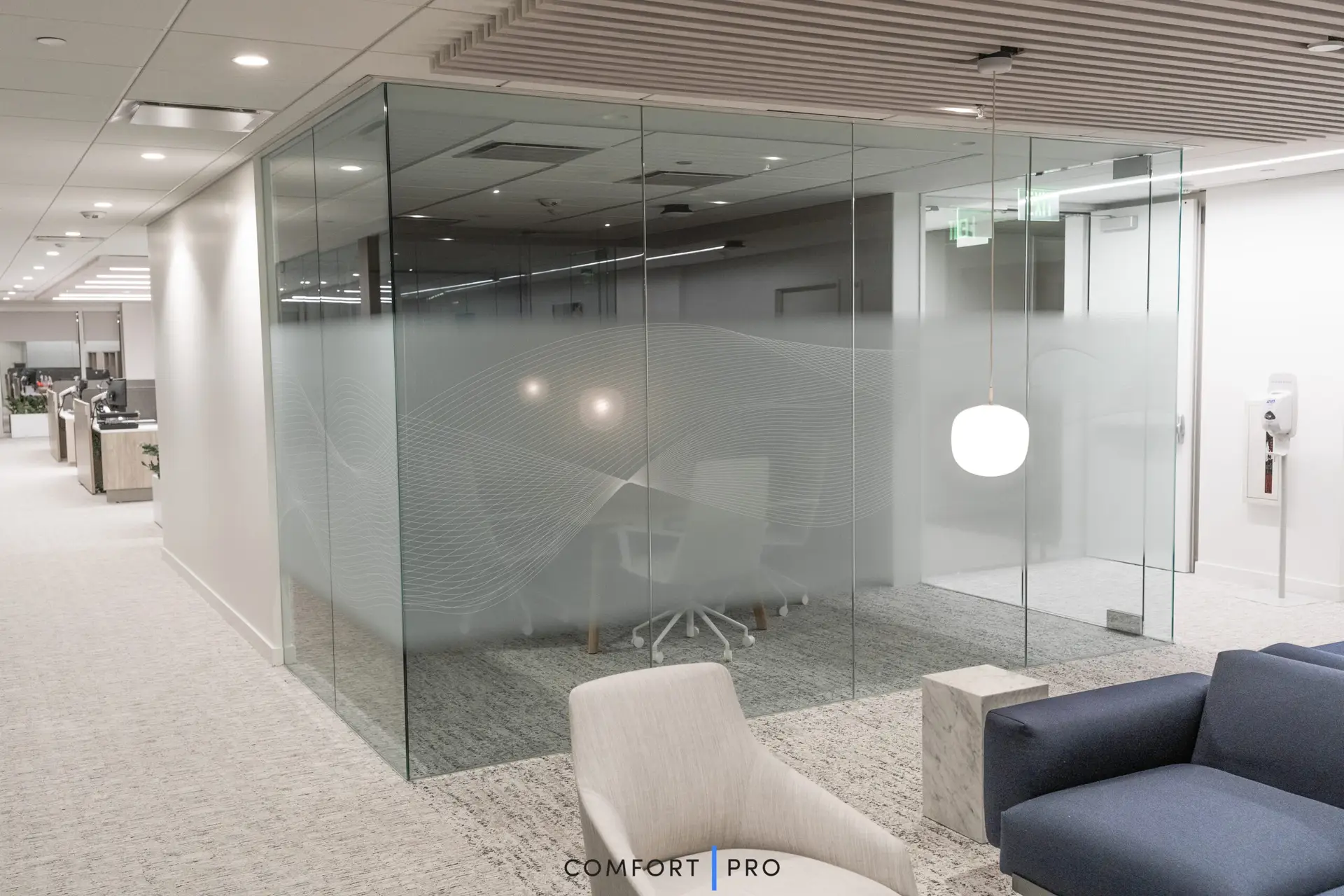
The strongest use is office glass that needs privacy anyway. Instead of a plain frosted band, the privacy layer becomes a design. At SoCal Gas Company’s executive offices in Los Angeles, Comfort Pro installed about 4,000 square feet of custom printed optically clear film. The executive offices needed branded graphics across a large amount of glass, finished on a tight schedule, and the work was completed in five days.
Combining print with frost
Print and frost can work together. At Collectors in Santa Ana, conference room privacy came from 3M Fasara Cloud combined with a custom printed design on optically clear film, across about 450 square feet. In a second project for the same client, about 700 square feet of Johnson Mirror Blue 20 mirror film was installed to match the upper blue glass, an example of print work sitting alongside other film work on the same building.

Wayfinding and suite identity
Suite numbers, department names and room names can be printed or cut into the same film that provides privacy, so the glass does two jobs without separate signs.
When a custom-cut frost is the better choice
Many offices that ask about printing end up with custom-cut frosted film instead. It is subtler, carries no ink, and stays consistent with the rest of a suite’s finishes. Navien’s corporate office in Irvine used custom-cut Solyx Clear Frost bands with the Navien logo. Symple Lending in Irvine used a custom-cut 3M Dusted Crystal band design along its office glass walls. For more examples, see our guide to office window frosting ideas.
As a rule of thumb, choose a print when the design needs color, photographic detail or fine graphic shapes. Choose custom-cut frost when one color of frost, a logo and a clean line are enough.
What to plan for
- Artwork. Large-format printing needs high-resolution or vector artwork sized to the actual glass. Logos pulled from a website rarely print well at wall scale.
- Viewing distance and light. A print looks different lit from behind by daylight than lit from the front by office lights. Look at a sample on the glass, at the time of day people will see it most.
- Both sides of the glass. On interior glass, people see the design from both sides. Decide which side should read correctly, especially if there is text.
- Brand approval. Corporate brand teams and landlords may both need to approve the design, which can add time to the schedule.
- Lifespan. Outdoor promotional graphics are often a shorter-term product than architectural film. 3M lists an expected performance life of one year for its perforated window film when unprinted and unprotected on a flat, vertical outdoor surface. Ask for the warranty and expected life of the exact film and print system being proposed.
- Removal. Many graphic and decorative films can be removed later, which helps tenants who may move. Confirm removal expectations for the specific film before installing.
- Signage rules. Graphics on street-facing windows may be treated as signage by your city or your shopping center. Check before you print.
Where printed film isn’t the right fit
- The real problem is heat, glare or fading. Graphics don’t replace a solar control film. If the glass faces strong sun, solve that first, then add decorative elements where they make sense.
- The glass needs strong, consistent privacy. A dense frosted film does that more simply than a print. A print can sit on top of frost if a design is still wanted.
- The design will change often. Seasonal promotions and frequently updated messaging are better suited to a sign or graphics vendor that specializes in short-run printing.
- Building wraps, wall murals and vehicle graphics. These are separate graphics products, mostly applied to walls, facades and vehicles rather than window glass. Comfort Pro’s focus is architectural film on glass, so ask early if your project goes beyond the windows.
Talk through your glass
If you’re planning privacy film for an office and want it to carry a design or your brand, Comfort Pro can review the glass, bring frosted and decorative samples and tell you whether a print, a custom-cut frost or a plain frost fits best. See our office decorative film page and commercial projects, or contact us.