A wall mural can make a lobby feel intentional, turn a blank corridor into branded space, or help a retail interior do more of the selling. But wall mural installation for businesses is not just a design decision. The finish on the wall, the amount of traffic in the space, lighting, cleaning needs, and installation quality all affect how the mural looks a month later, not just on day one.
For business owners and facility teams, that difference matters. A mural that bubbles, lifts at the seams, or shows damage too quickly stops feeling like an upgrade and starts feeling like a maintenance issue. The best commercial mural projects pair the right visual concept with the right surface material and careful installation.
Why wall mural installation for businesses needs planning
Commercial interiors are harder on wall graphics than most people expect. Offices have cleaning crews, retail spaces have carts and customer traffic, healthcare and education settings have stricter maintenance routines, and common areas often have textured or previously painted walls that can complicate adhesion.
That is why installation should start with the wall itself, not just the artwork. A smooth, properly prepared painted surface usually gives the best result. Fresh paint can be a problem if it has not cured long enough. Heavily textured walls may require a different product or a different approach altogether. In some cases, a printed wall film works beautifully. In others, a rigid sign panel or another branded surface application may hold up better.
This is also where professional guidance saves time. A mural that looks great in a proof can still fail if the substrate, adhesive, and environment are mismatched. Businesses usually benefit from a recommendation based on use, wall condition, and expected wear rather than choosing a material by appearance alone.
What a business mural is really expected to do
Most commercial murals are doing more than one job at once. They are decorative, but they also support branding, improve the customer experience, reinforce culture, or help large spaces feel more finished and less generic.
In an office, a mural may communicate company identity in reception areas, conference rooms, or training spaces. In retail, it may create a stronger backdrop for products and make the store more memorable. In schools, medical offices, and multifamily properties, murals often soften the environment and make it feel more welcoming.
There is also a practical side. Some wall graphic materials can add a layer of surface protection in high-contact areas. That does not mean every mural is a substitute for dedicated wall protection, but in the right setting, a durable film can help reduce visible wear on painted walls. If a business is balancing appearance with longevity, that trade-off should be discussed early.
Choosing the right material for wall mural installation for businesses
This is where many projects are won or lost. Not every mural material performs the same way, and the best option depends on the wall, the artwork, and the environment.
Vinyl wall coverings are common because they are versatile, printable, and available in different finishes. Some are designed for smooth walls and permanent use. Others are removable or repositionable, which can help in leased spaces or short-term campaigns. If a company updates branding often or uses seasonal promotions, a removable film may make more sense than a long-term adhesive system.
For higher-end interiors, textured or fabric-look wall coverings can add depth and help the mural feel integrated into the space rather than applied on top of it. These can be a strong choice for hospitality, executive offices, and branded customer-facing environments where the finish matters as much as the graphic.
Durability should be weighed honestly. A beautiful matte finish may be ideal in a low-contact conference room. In a hallway, break room, or retail area with regular cleaning, a tougher finish may hold up better. If the mural is likely to be touched, bumped, or cleaned often, the surface needs to match that reality.
Wall prep, measurements, and print accuracy
Clean design does not fix poor prep. Before installation, the wall should be checked for dust, grease, patching residue, paint failure, moisture issues, and texture inconsistencies. Even small imperfections can become more visible once a large-format graphic is applied.
Measurement accuracy matters just as much. Commercial walls are rarely as square as they appear. Ceiling lines drift, corners lean, and outlets, trim, and doors introduce details that need to be accounted for before printing. Good installers plan for these conditions so the visual lands correctly once the material is on the wall.
Print quality is another factor businesses should not overlook. Brand colors, image resolution, and panel alignment all affect the final result. A mural viewed up close in an office lobby needs different file discipline than a graphic meant to be seen from across a store. If the artwork includes logos, typography, or precise brand standards, production and installation need to work together closely.
What installation day should look like
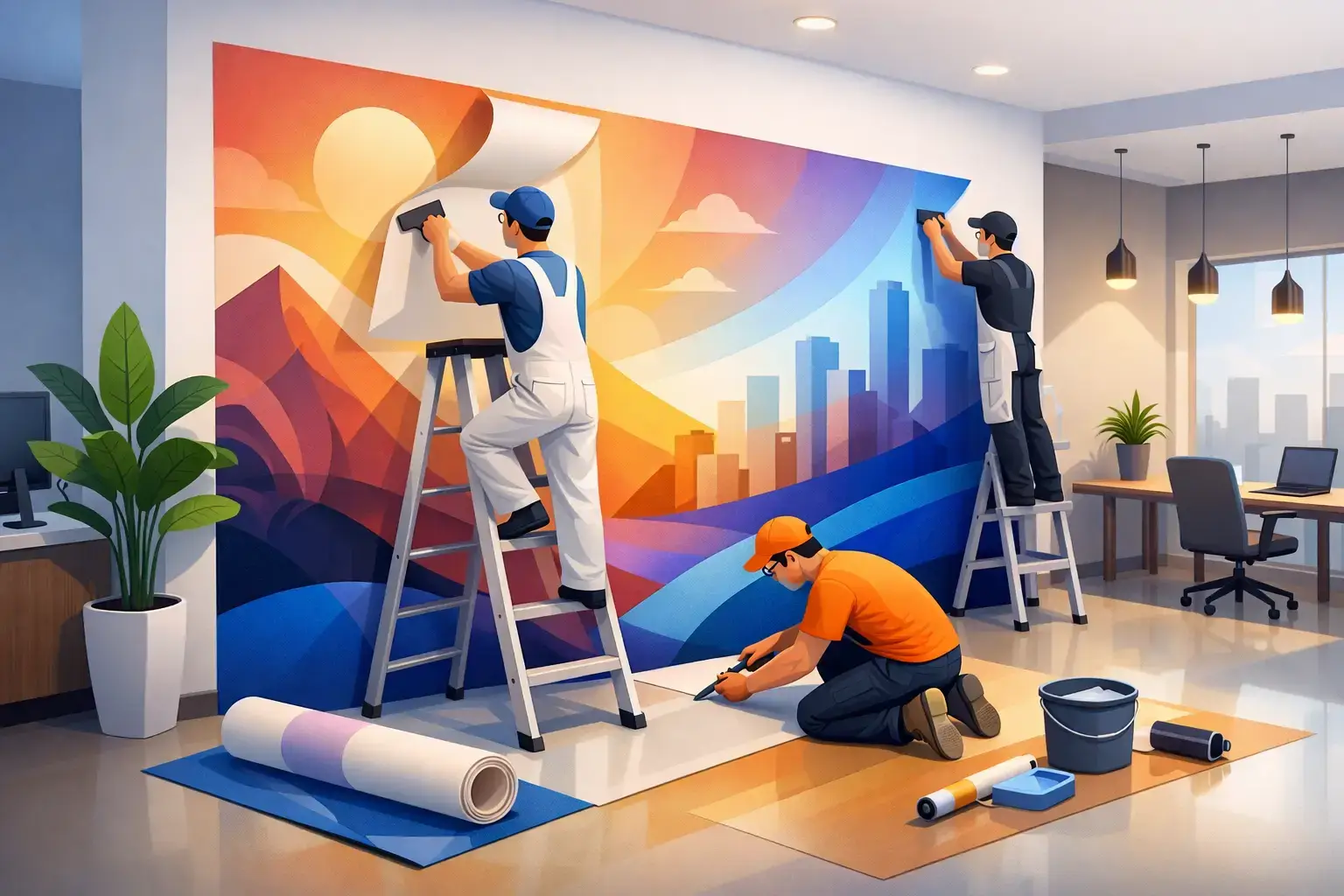
A professional commercial installation should feel organized. The space is protected, the layout is confirmed, the material is acclimated if needed, and each panel is aligned with attention to seams, corners, and finish details.
For occupied businesses, timing is often part of the project. Some installs can happen during business hours with minimal disruption. Others are better scheduled after hours or in phases, especially in retail, medical, education, or office environments where access and cleanliness matter. The right schedule depends on traffic, noise tolerance, and how sensitive the space is to interruption.
This is also where experience shows. Large murals are not just stuck to a wall. Installers need to manage expansion, tension, overlap or butt seams, cut lines, and problem areas like inside corners, wall plates, and transitions. The goal is a finished look that feels built into the space, not pieced together.
Common issues and how to avoid them
The most common mural failures are predictable. Poor adhesion often traces back to incompatible paint, insufficient wall prep, or a textured surface that was never a good candidate. Edge lifting can happen in humid areas or where cleaning and friction are constant. Visible seams may result from rushed installation, unstable walls, or unrealistic expectations about the material.
There are also design-related mistakes. Dark murals show scuffs more easily. Intricate patterns can make seams more noticeable if the wall is uneven. Very light colors can highlight wall imperfections underneath. None of these are reasons to avoid a mural, but they are reasons to plan with the real space in mind.
That is why a site assessment matters. A business may want one look, but the wall may call for a slightly different material, finish, or layout. The best result usually comes from adjusting the plan before production rather than trying to force a perfect rendering onto an imperfect surface.
Where murals make the biggest impact
Some of the strongest business mural projects are not the largest ones. A well-placed feature wall in a reception area can change how a customer experiences the brand within seconds. A corridor mural can help a workplace feel more polished and less transitional. In retail, a branded wall can support merchandising without taking up floor space.
Conference rooms, waiting areas, elevator lobbies, and tenant improvement spaces are all good candidates. So are privacy-sensitive spaces where decorative films and wall graphics can work together to create a more cohesive environment. For businesses already investing in interior upgrades, murals often make the surrounding finishes feel more complete.
In California markets where design expectations are high and commercial interiors are competing for attention, details like this can influence perception more than people realize. A thoughtfully installed mural signals care, consistency, and professionalism.
Maintenance and lifespan
Once installed, a mural should be maintained according to the material and finish. Some surfaces can handle regular wiping with mild cleaners. Others need a lighter touch. That is worth clarifying upfront, especially in facilities with standardized cleaning protocols.
Lifespan depends on wall condition, exposure, traffic, and whether the mural is decorative or expected to take some abuse. A low-contact office mural can stay sharp for years. A hallway graphic in a busy commercial setting may show wear sooner, even with good material. That is not a flaw so much as a use-case issue.
Businesses should also think about future changes. If a space may be rebranded, remodeled, or re-tenanted in the near term, removability matters. If the goal is long-term branding in an owned or stable space, a more permanent solution may be the better investment.
A strong mural does more than fill a wall. It helps a space communicate, perform, and hold up under real-world use. When the material, wall condition, and installation are handled with care, the result feels less like decoration and more like part of the business itself.