
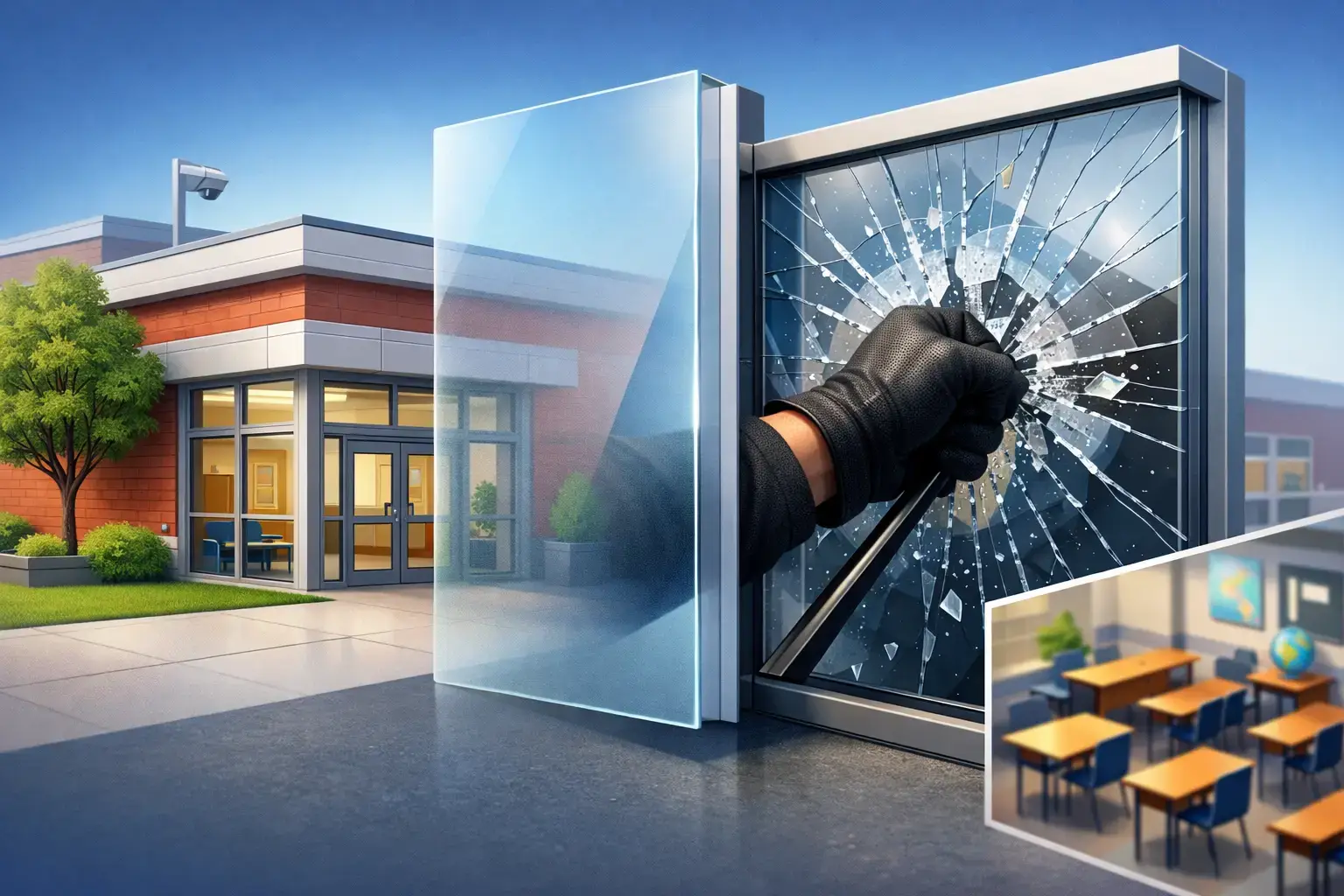
A school’s glass doors, sidelights, entryways, and ground-floor windows serve valuable daily purposes: visibility, natural light, supervision, and a more welcoming campus. They can also be points of concern when a facility team reviews safety. Security film for schools is designed to address one important part of that conversation by helping broken glass stay together after impact.
It is not a substitute for controlled access, trained staff, emergency procedures, or properly designed security hardware. It is a practical glass-protection upgrade that can improve the performance of existing glazing while preserving the appearance and light schools rely on every day.
What Security Film Does for School Glass
Security window film is a clear, heavy-duty polyester film installed on the interior surface of glass. When glass breaks, the film helps retain fragments in a more cohesive sheet rather than allowing them to scatter immediately into the room. This can reduce hazardous flying or falling glass and make the opening more difficult to pass through.
That distinction matters. Standard glass can fracture quickly under impact. A professionally selected security film system adds tensile strength and holds broken pieces together. Depending on the glass, frame, film thickness, and attachment method, it may help delay entry through a broken pane and reduce the size or openness of the breach.
For school leaders, that added time can be meaningful. It can support response procedures, help protect interior occupants from glass debris, and provide another layer at vulnerable areas. But film is not bulletproof, and it should never be described as making a window impenetrable. Performance depends on the complete glazing system, not the film alone.
Where Security Film for Schools Makes the Most Sense
A campus-wide installation is not always necessary or the best use of a facilities budget. The strongest approach begins with a site assessment that identifies glass most exposed to impact, unauthorized access, or high pedestrian traffic.
Entry doors, sidelights, and vestibules
Glass next to locked doors deserves close attention. A door may have reliable locking hardware, but an adjacent sidelight can create a vulnerability if it can be broken and reached through. Security film can help reinforce these glass surfaces while maintaining sightlines into the entry.
Vestibules, reception areas, and visitor check-in locations also benefit from clear glass that remains visually open. Unlike opaque barriers, clear security film can preserve the appearance of the entrance and allow office staff to monitor arrivals.
Ground-level classrooms and exterior-facing windows
Windows close to walkways, parking areas, playgrounds, or public-facing edges of a property can face greater exposure to accidental impact, vandalism, or forced entry attempts. Film can help contain broken glass from either side of the pane, which is useful in classrooms, corridors, libraries, and multipurpose spaces.
For older campuses with extensive existing glazing, film may be a more manageable upgrade than replacing every window immediately. That does not mean it is the right answer for every opening. A glazing professional should evaluate the glass type, condition, frame, and surrounding construction before specifying a solution.
Interior glass in high-traffic areas
Safety film is also worth considering for interior partitions, doors, and glass near stairways or busy corridors. In these applications, the primary benefit may be injury reduction rather than access resistance. If the glass breaks, fragment retention can help limit the spread of sharp shards into occupied areas.
Safety Film and Security Film Are Not Always the Same
The terms are often used together, but the intended outcome should guide the product selection. Safety film is commonly chosen to hold glass fragments together after accidental breakage or an event such as severe weather. Security film is typically thicker and selected where a school wants stronger resistance to impact and forced entry.
Some projects need both benefits. Others need a targeted solution focused on one issue, such as a glass partition near student traffic or a sidelighted exterior door. Choosing by film thickness alone can lead to disappointing results. The film must match the risk, the existing glass, and the frame system.
Attachment is another major consideration. In higher-security applications, a structural attachment system may be used to connect the filmed glass more securely to the frame. Without proper anchoring, the glass may remain intact as a sheet but still separate from the frame under enough force. This is why a professional recommendation should consider the entire opening, not just the visible pane.
The Trade-Offs Schools Should Consider
Security film offers meaningful benefits, but it works best when decision-makers understand its limits. It cannot correct damaged frames, inadequate locks, failing door hardware, or poor access-control practices. It also cannot turn ordinary glass into a complete security barrier under every type of threat.
There can be visual and operational considerations as well. Most clear security films have very little visible change, but thicker products can create a subtle appearance difference at certain angles. Existing glass may have scratches, chips, failed seals, or coatings that affect installation options. In some cases, glazing replacement or frame repairs should come before film.
Schools should also account for code requirements and daily operations. Egress doors, fire-rated assemblies, specialty glass, and historic buildings may require extra review. The best installation plan protects people without interfering with life-safety functions, maintenance access, or the campus’s normal use of natural light and visibility.
A Better Way to Plan the Project
A film project should start with clear priorities rather than a generic product request. Facility managers can begin by identifying which openings concern them most, why those openings are vulnerable, and what result they need from the upgrade. Is the goal to reduce glass hazards? Add resistance at an entrance? Improve privacy and safety at the same time? Those answers shape the right scope.
Next, document each opening. Note the glass dimensions, whether it is single or insulated glass, the frame material, its location, and any existing damage. Door sidelights and transoms should be included, not just the main window panels. A detailed survey prevents missed openings and creates a more reliable estimate.
Then consider how security film fits with other improvements. A reinforced glass opening is most effective when paired with functioning locks, appropriate door hardware, controlled visitor access, and clear emergency protocols. Layered planning is more useful than expecting one product to solve every security concern.
For larger districts or multi-building private schools, phased installation can be sensible. Start with priority entry points, high-risk ground-floor glazing, or areas identified through a security assessment. This makes budgeting easier while delivering protection where it matters first.
Why Professional Installation Matters
Film quality matters, but installation quality determines whether the finished system performs and looks as intended. The glass must be carefully cleaned and prepared so the film adheres evenly. Precise trimming is essential around gaskets, frames, handles, and door hardware. Small errors can affect appearance, durability, and edge performance.
Professional installers also recognize when a window should not be filmed until another issue is addressed. Damaged glass, compromised seals, excessive frame movement, and incompatible surfaces should be evaluated before work begins. That honest assessment protects the school’s investment and avoids treating film as a shortcut around larger glazing problems.
For schools in Southern and Northern California, Comfort Pro can help facility teams assess existing glass, explain film and attachment options in plain language, and plan a clean, carefully coordinated installation around campus operations. The objective is straightforward: improve protection without creating unnecessary disruption for students, staff, or visitors.
The Right Upgrade Starts With the Right Questions
The best security film project is not defined by the thickest product or the largest rollout. It is defined by whether the selected system addresses a specific vulnerability, works with the existing glass and frame, and supports the school’s broader safety plan. A careful assessment of the openings that matter most gives decision-makers a practical path forward while preserving the light, visibility, and welcoming environment a school needs.